Yes. My back yard is okay.

A profound NIMBY attitude has coalesced in opposition to certain elements of the Envision Taylor comprehensive plan. That opposition is starting to show up on Taylor City Council agendas (just look at item 13 on the current agenda — then consider how this might play out in next week’s joint meeting between the P&Z and the council — right, there’s nothing at that link because the city hasn’t posted anything yet).

I encourage everyone — especially our new council members and candidates — to recall that more than 150 people engaged with the process that wrote a plan that specifically protects the character of this town while also encouraging a conservative, fiscally responsible approach to development. It took more than two years. That’s a lot of work. 

Let’s not forget that it’s primary purpose of this effort was to introduce fiscal responsibility into our land development code, while also letting let folks do what they want with their property within reason. It also helps protect our community from out-of-town, corporate developers who are just looking to make a quick buck before scurrying back to Austin or Houston or Dallas.

As far as I can tell, few if any of our neighbors who most vocally oppose the plan cared enough about the future of our community to participate in those workshops. That includes at least one current member of the council and at least two candidates. Hell, I’m not sure any of our current council candidates attended more than one of those workshops.

I do understand that the NIMBY-ites are loud. And many are active in electoral politics — at least, they are in the background, and likely contribute to local campaigns. But they didn’t care enough to help shape the plan in a way that might have addressed their objections to building condos or townhouses, or breaking up large lots to build smaller homes in the core of our town. Further, they won’t show up to future land use public meetings because they never have and they never will. They just need to wield torches and pitchforks.

Now, while I understand the concerns being raised, it’s not controversial to say that a residential home never pays enough property tax to account for the public services it consumes — and, the larger the lot it sits on, the larger that gap is. A single family home is a tax liability forever. In other words, if we truly care about taxpayers, the city needs to encourage “high density” housing as described above. Not discourage it.

Another quick, but related comment. I’ve heard that a driving force behind trashing our comp plan is that “we’re behind on housing,” and developers say Taylor is difficult to work with and blame the comprehensive plan for this. 

Huh. 

During his State of the City address to the Greater Taylor Chamber of Commerce on Monday, Mayor Ariola told us that more than 900 residential housing units involving at least three developers are currently under construction in Taylor. Further, more than 6,000 units from 15 different developers have already been permitted and are in the pipeline, presumably waiting for interest rates to moderate. Apparently, some developers are just fine with Taylor’s land use code. 

Perhaps the real situation is that corporate developers who plow up farmland to throw up 2x4s and drywall in cookie-cutter neighborhoods, like those we see in Hutto and elsewhere, don’t want to alter their plans to fit our needs. And some of those developers have the ear of some of our candidates, and some on our city council. 

We, as a community, invested a lot of resources into the current plan, a plan that ensures that our development efforts will stretch our tax dollars as far as possible and not saddle us with future tax liabilities. The comp plan — and the land use code it enables — is a conservative, fiscally responsible document. Yes, it is a living document but like all guiding charters, we should approach changes to it with a scalpel, not a chainsaw.

I, for one, am damned proud of the work we did to see that our city gets the biggest possible bang for our tax dollars while protecting the unique character of our town.

For additional reading on why our current plan is good for Taylor, our economy, our tax base and our overall standard of living, read this.

Also, I addressed the issue of participation last summer. You will find that commentary here.
Don’t be one of those people who gripe only after all the work is done

This essay began this life on the digital page in response to a recent social media post. But the genesis was in March and April, during the run up to the most recent city elections.

That election turned out to be a referendum on the Envision Taylor Comprehensive Plan, with bike lanes and infill development front and center. The incumbent in one race doubled down on his support. His challenger spent thousands of dollars bashing it. In public, she said she was “familiar” with the plan but was dismissive of the process.

Throughout the campaign, misinformation about the comp plan spread across our local Facebook pages, and into some campaign literature. Various factions used the opportunity to deliberately misrepresent it.

Among the many misrepresentations was one that concerned the process: the city conducted the workshops at inconvenient times and did a poor job of marketing. As a result, too few people participated.

As one who invested months into that project, I found that more than a little insulting. I still do.

While I agree that more people could have participated, one should remember that voter turnout for municipal elections is also pretty poor. Perhaps there’s a correlation.

This position shows a stunning lack of respect for the hard work that citizens of our community put into the new plan, one that was “Taylor Made” and would protect the cultural and historic nature of this town.

That was our charge, and we took it seriously.

Meetings were held over Zoom and in person; in the afternoon, early evening and weekends, beginning as soon as the ‘Rona let up a bit and for the following 18 months or so. It’s true that most had 100, or fewer, people in attendance but more than one or two were standing room only.

The schedules were posted in the expected places and on the appropriate platforms: the paper, the city newsletter, on its website and on all the city social media. The meetings were streamed live on Facebook and the city’s website.

I understand that the sessions were inconvenient for a lot of folks. People will always have more important things to do … like work or care giving or whatever. And I’m not mocking that — those are important things and often cannot be deferred.

I can take the time to attend meetings like this. I’m semi-retired, and given that I’ve followed municipal government professionally for decades, I was motivated. Plus, I’m a public policy nerd.

But, if you didn’t know about the meetings, it’s because you weren’t paying attention. If you couldn’t find the time to attend, whatever the reason, no judgement but that’s on you.

Now, I think it’s great that more people have become more engaged. The more voices at the table, the more likely more people will buy into the results. I hope they stay engaged, but I wonder and here’s why: The same 150-200 citizens show up to virtually every city function I’ve attended over the last 10 years.

It’s the folks from that pool of around 200 people who show up for efforts like the work of the Greater Taylor Foundation, or who spent the time to help develop the Envision Taylor Comprehensive Plan. Or a myriad of other projects undertaken for the good of the community as a whole. They don’t care about gotcha politics, or the most recent cultural outrage. They aren’t posting snarky, knee-jerk pot-shots on social media, bashing their neighbors who are just trying to serve.

No. They don’t wait around. They get things done.

Should any effort to re-write the comprehensive plan be in the works, I can’t help but wonder at how many of these newly engaged people will show up, meeting after meeting, for 12-18 months, to help modify it in a way that protects the culture and history of Taylor but also meets the fears and perceptions of a loud group of keyboard commandos who are often angry and suspicious at anything that reeks of “planning for the future.”

City planners set their course based on the voices of the people who show up, not the people who gripe — after the fact! — on social media. So, don’t wait until your neighbors have already devoted months of work to complain about the outcome. Be intentional, be part of the process. Get involved early and show up when and where it matters.

If you can’t do that, please show a little respect and accept that the resulting work was done with your neighbors’ best intentions.

Note: I replaced the original essay with the version I edited for print. It appeared in the July 7 edition of the Taylor Press.

How we got here — a brief history on our electrical grid

It’s been a minute or three since I shared my thoughts here. Who knows if anyone is still watching.

I should note that it is currently 18º outside with 15 mph winds from the north west, so it feels damned cold. Hell, it is damned cold. It didn’t get above freezing yesterday. If the weather gurus are correct, it won’t get above freezing today, and will be even colder Tuesday morning.

That said, this is a fairly normal hard freeze — the kind of event we see nearly every year. Indeed, we WANT this sort of thing to happen annually because it’s good for the fruit trees and and bad for pesty insects.

But our grid traffic cop (the Electric Reliability Council of Texas) is pleading with us to conserve energy until about 10 a.m. — and has asked us to do the same tomorrow morning because demand is expected to be greater than our electrical providers can supply.

In short, the self-proclaimed energy capital of the world (Texas) can’t guarantee the heat and lights will stay on during a normal winter freeze. I don’t know about you, but that’s giving me flashbacks to the Winter of 2021.

I didn’t think winter-related PTSD was a thing, but here we are.

Anyway, for those of you who are new to our great state, or maybe didn’t pay attention 30-ish years ago, here’s a bit of history about our electrical grid and how we came to be in this mess.

Our “grid” was regulated up until the early aughts. That’s when we (state government) moved to an unregulated energy market.

In the before times, electricity was supplied by a virtual monopoly that was strictly regulated (remember TXU or Ready Killowatt?). Rates were regulated and infrastructure updates, upgrades and expansion were mandated, but the monopoly was guaranteed a healthy profit.

Along came Enron, and an effort in California to de-regulate the industry because competition is a good thing. Seeing big bucks, Enron got inside the pockets of a bunch of Texas politicians. It convinced them that what California did was a real good start, but Texas could do better.

Not too long ago, I read a great story about a powerful Democratic state senator, a trip to California on an Enron jet, and a energy market plan sketched out on the back of an envelope over three or four glasses of Glenlivet during the flight back. I’ll try to find it and post a link, but search “Texas electricity deregulation,” on the Google machine and you’ll find a ton of stuff.

Anyway, we broke up the monopoly in the name of competition, de-coupled production from delivery, de-regulated prices (also in the name of competition) and, basically, fully implemented Enron’s wet dream of a completely open, unregulated energy market.

What could go wrong? Well, for one thing, Enron famously went bust. Y’all remember that, right? It was a pretty big, pretty messy deal.

Our state’s leaders waved that Enron bankruptcy away like an annoying whisp of fog and de-regulated our energy markets anyway. It was supposed to mean we paid the lowest energy prices in the country, and for a while, things were pretty rosy. However, those lower prices came at the expense of expansion of capacity and regular upgrades.

The practical effect is that industry has little or no incentive to ensure there is enough energy available, and at a decent price for consumers, when conditions tighten. Instead, it benefits industry that supply is low when demand is highest, because it jacks up the price. Capitalism, baby! Competition!

There is also little incentive to expand capacity because, well, supply and demand. Again, capitalism, with very little in the way of consumer protections. In fact, a recent court case ruled that energy providers are under no obligation to supply adequate services, even during a weather emergency.

Thus, ERCOT and the energy markets are working today exactly as they were designed to 20 years ago. It’s just that it was not designed for us, the consumers. It’s designed to maximize profits while minimizing industry costs and it’s working quite well, thank you very much.

Do you want this to change? Do you want a little more transparency, better price protections, a more robust grid?

Well, you’ll need to talk to your state legislator. In our case in Taylor, as in many districts, that legislator is supported by the very same interests that foisted this market upon us — maybe not the exact same people (tho some are), and those interests have other interests these days (like banning books and women’s health care, and destroying public education as we know it), but they are the very same interests.

To paraphrase a line from one of my favorite movies, “Never underestimate the lengths a West Texas oil oligarch (or three) will go to when money is on the line.”

Y’all stay warm, if you can.

Nothing good can come of this

Thursday’s Taylor City Council meeting was both disappointing and embarrassing.

On the one hand we have the people who came out to speak in opposition to a proposed increase in the council’s compensation (or honorarium). On the other, we have the actual vote the council took.

I served on the compensation committee. After the issue went off the rails in July, when our chair reported our recommendation, I decided to speak in defense of our work — essentially in opposition to the ordinance as presented. My remarks are appended below.

Many of those who spoke in opposition used the opportunity to make vicious, personal attacks on sitting council members. Every time a speaker “scored a hit,” people in the council chamber could hear the overflow crowd whoop and cheer.

The longer I sat there, the more embarrassed and disgusted I became. It was disrespectful and unbecoming.

Some kept their remarks civil — proving that there IS such a thing as civil political discourse, I guess — but too many people ranted at the council and took unnecessarily personal shots at individual members. I actually began to feel dirty for being in the same room with the hatefulness.

That said, I was stunned that the council voted 3-2 to approve a compensation package that eclipsed those of some larger cities in the area, with no explanation of why they voted the way they did. That they voted to make this compensation effective with the beginning of the fiscal year, Oct. 1, rather than waiting until each office was re-elected is inappropriate, and I said this in my remarks. 

I also believe that the cavalier way this was accomplished has forever changed the political discourse in this community, and not in a good way.

Folks, very few of you behaved particularly well last night.

____________________________________________

Remarks to Taylor City Council, August 17, 2023

Thank you Mr. Mayor, Council.

My name is Richard Stone. I live at 1306 Cecelia St. I was a member of the committee tasked with making a recommendation to council about this and I’m here this evening to speak against Ordinance 2023-40 as presented.

The recommendation we submitted resulted from our examination of our charge, Section 4 of the Charter, a study of how other, similar-sized communities compensate their council members and careful attention to what members of the community said.

We believed it important that we understood the expectations laid out in the Charter.

All it says in regard to compensation is that council members be paid for two meetings a month. There are no expectations outlined. In fact, other than general qualifications, there are no expectations toward council activities at all. The charter doesn’t require visible attendance at community events, or that council members have an active social media presence or anything. It doesn’t require that members of the council be prepared for meetings — if I read it correctly, it doesn’t even require attendance.

I do believe it is important that members be visible and active at as many functions as they can because it allows the general public access to you, our elected representatives, but this is why we recommended it be examined by the next Charter Review Committee. Maybe there should be some minimum expectations.

Regarding the amount of the compensation — we asked the city staff to research cities similar in size and location to ours — not just other communities in Williamson County, but across the State of Texas. About one third of the cities surveyed didn’t pay council at all, or so little it could be disregarded for these purposes.

The rest ran the gamut. Knocking out the outliers, and allowing for population and administrative differences, I believe a straight-line reading of the research would have supported an honorarium of $175-$250 a meeting, but based on our outreach, I did not believe that would have broad community support.

Make no mistake, the majority of those who responded to our outreach agreed that $12.50 a meeting is too little. There is support in the community for raising council’s compensation, but this is excessive — and is as much or more than other, much larger cities, even in Williamson County.

Further, the majority of your constituents who responded to our outreach believe that it would be conflict of interest for you to give yourselves a raise — I believe this as well. 

It is your decision, of course. If you believe that it’s important to increase your honorarium by this amount — even though it is a dramatic and startling departure from the recommendation made by the committee you appointed — at least be transparent, and have it effective only after each of you have won re-election.

It’s the ethical thing to do.

A slippery slope

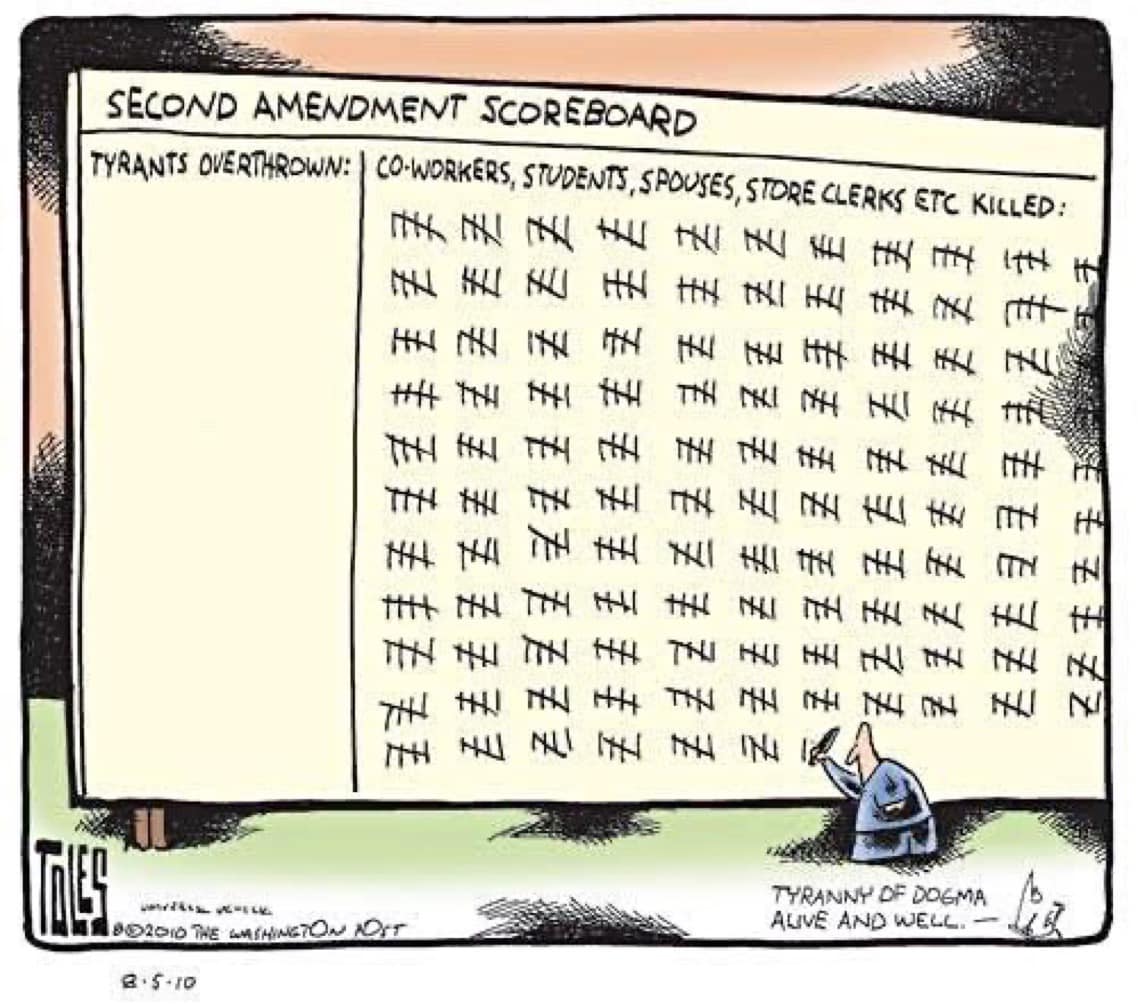
This editorial cartoon has been around a while and it is as relevant today as it was when it was first published in 2010.

That’s both a testament to the power of editorial cartoons and to the general state of our society. Nothing has changed since 2010. Indeed, it’s only gotten worse.

I posted this cartoon to my Facebook page shortly after the most recent massacre — the one outside a shopping mall in Allen, Texas, in case another one comes along before you read this, which isn’t unlikely — and appended the comment, “Let’s go to the scoreboard, shall we?”

The post didn’t get a great deal of traction, not that I expected it to. It was simply an expression of my frustration. But it did elicit a comment from a FB friend, someone I know IRL.

“I’d personally like to see some safeguards put in place but it’s a slippery slope and therein lies the difficulty.”

Huh. A slippery slope.

Right now, as far as I’m concerned, that slope is slippery because it’s coated with blood.

Please. Please. Doing nothing — which is what this phrase translates to — doesn’t help. We need solutions, not a phrase slightly less offensive than “thoughts and prayers.” Thoughts and prayers aren’t working, either.

Those working to reduce gun violence have offered some solutions, and a majority of Americans support those proposals. Background checks. Waiting periods. Red flag laws. Most Americans even support curbs on the weapons and accessories most likely to be used in a massacre.

But we are unlikely to see any of this until we begin to see daylight between 2A advocates and 2A absolutists. Right now, that particular venn diagram appears to be a full circle.

The harsh truth is that any set of solutions to this problem — you know, massacres at schools and shopping malls, getting shot because you got in the wrong car or rang the wrong doorbell or, heaven forefend, played hide-and-seek too close to your neighbor’s yard — will not come from people actively working to reduce gun violence. These solutions will come only when 2nd Amendment advocates finally become sick of seeing children slaughtered outside a shopping mall or in a classroom.

Only then will they separate from the absolutists. 2A advocates need to get serious about this because the absolutists are not serious people.

The thing about that particular editorial cartoon is that it was published not long after Sandy Hook. That was a watershed moment for this country. It’s when 2A advocates and absolutists locked arms and decided that the slaughter of 2nd-graders was a small price to pay for ” … our God given right to own guns.”

A couple of final points:

Some of you are going to point to the mental health of the murderers and say we need to address that. Fair point. The people who do this on a mass scale are certainly sick. So are those who use lethal force against imagined slights on the retail level.

However, treating the mental health of these people doesn’t seem to be a priority of our leaders. Last I checked, Texas is tail-end Charlie when it comes to the resources we devote to mental health care —51st in the nation (yeah, including the District of Columbia), never mind the practical issues with providing this sort of care to people who don’t want it.

So, until we are ready to invest adequate resources in mental health care, just miss me with that argument. It’s weak.

The other point some of y’all will raise is the chestnut about the futility of enacting laws that no one will follow, or something like that. With that attitude, why bother passing laws against drunk driving or drag shows or abortion?

A Twitter-journalist-friend expressed it very well earlier this week. You can find her thoughts on this here: https://threadreaderapp.com/thread/1655709500936945668.html

I’ve felt the way @txnewsprincess does for quite some time. You can miss me with this argument, too. I don’t really want to hear your rebuttal.

Related: Our new normal: When tragedy becomes commonplace

Mail ballots woes afflict WilCo voters

Note: This news story was published Feb. 24, 2022 in the Hill Country News. I offer it here in case one of my readers is among the 100 WilCo voters who used the Texas Secretary of State’s website to correct a mail ballot application in February.

When Jo Stone was notified in January that her mail ballot application had been rejected, she tried to fix it.

As instructed, she logged on to the Texas Secretary of State’s website and believes she did everything she was asked in order to correct her application. Indeed, before she logged out, she was told that her application had been successfully corrected.

Yet, when she checked back with the WilCo elections website, she saw that her ballot application was still declined.

“I’m just going to vote in person,” she said, exasperated. Though a senior, Stone has no trouble getting around and lives only a few blocks from her regular polling location in Sun City. In the past, she has served as an elections clerk at that location and has voted by mail in Texas for more than a decade.

“We notified her and she corrected the application on the state’s mail ballot application tracker,” confirmed Julie Wassnik, WilCo’s voter registration supervisor. “We did not get that information from the state’s tracker. The last time we got [an update] was at the end of January.”

Stone was one of at least 100 WilCo voters who used the Secretary of State’s website to correct an application or mail ballot since Feb. 1, but whose corrected information languished in Austin until Feb. 22.

“We realized around the middle of February that we weren’t getting updates,” said Wassnik. She said her office notified the Secretary of State but nothing happened. Wassnik began taking screen shots of the state’s notification dashboard in order to update local records, but the corrections voters made between the first and middle of the month weren’t made.

Assistant Secretary of State for Communications Sam Taylor said that the state and counties like Williamson routinely sync voter databases overnight. He said this issue should have been caught during that process.

“Our office has been working to provide regular updates of all voters statewide who have used our Mail Ballot Tracker to verify mismatched ID information on their Applications for Ballot by Mail (ABBMs),” he said in an email response. “This morning, we provided a comprehensive electronic file to all 38 counties to make sure they had a full list of all voters who had corrected any missing or mismatched ID information before the Feb. 18 deadline.”

Taylor said that the county should have received regular updates.”We’re reviewing the sent files with our vendor and the offline county vendor to confirm when those updates were received,” Taylor said.

WilCo elections chief Chris Davis insisted that his office had not received an update from the state since Jan. 31.

The WilCo elections office said that Stone’s application was initially declined because she wrote the the final digit of her drivers license number incorrectly. Had she included her Social security number, which she had also provided when she registered to vote, the application would have been accepted.

“This is illustrative of what’s happening across the state,” Davis said. “All Texas counties are struggling with this and it’s going to be an issue until people get used to it.”

Stone fell victim to the more complicated mail ballot process enacted last year as part of the Texas Legislature’s effort to “secure” the state’s elections. Voting rights advocates have called the law an effort in voter suppression.

“We are seeing very high defect rates,” Davis acknowledged. The main reason applications and mail ballots are rejected have to do with the identifying numbers that must be included. “We are going to have more mail ballots rejected than at any time in the past because of these numbers.”

The new law requires voters who vote by mail to include either a Texas drivers license number or the last four digits of the voter’s Social Security number. Voters had to provide one of those identifying numbers when they registered to vote. Some voters included both numbers when they registered. Many don’t remember which one they provided.

Some Texas counties are seeing defect rates approaching 40%. In WilCo, the rate is significantly lower. Davis predicted that the rate will be closer to 20% of all mail ballots. He said his team has tried very hard to reach out to mail ballot voters in an attempt to clear them up.

“If we have a phone number, an email address on file, we try to help voters fix it because they are curable,” he said, but noted that “that window is closing … fast.”

To be safe, Davis suggested that voters include both numbers in the space provided underneath the flap of the mail ballot’s return envelope.

Even though the county finally approved her mail ballot application, Stone called the election office Tuesday morning and cancelled her mail ballot. She said she planned to be away from the city later in the week and wanted to vote in person before she left. Had she not cancelled the ballot application, she would have been been on the rolls as having received a mail ballot and been forced to cast a provisional vote.

It’s too late to apply for a ballot by mail, Davis said. For a mail ballot to be counted, it must be postmarked no later than 7 p.m., March 1. And, if you choose not to mail it, be sure to take it with you when you vote in person.

If you do vote by mail, Davis had a final bit of advice.

“Put both numbers on your ballot.”

Note: Jo Stone is author’s mother.

A boring government is one worth fighting for

Jim Penniman-Morin and I are locked in a good-natured battle over who first said that government should be boring.

To be honest, I’m not entirely sure that Jim cares but that would make for a poor analogy so I’m going with my version of this story.

Jim is a member of the Cedar Park city council and is running to succeed Corbin van Arsdale as mayor. I scrolled back through Jim’s social media to see if I could pinpoint when he first uttered that sentiment but could find very little. Unless he said it at a campaign event, I only know for certain that he said it during a Cedar Park Chamber candidate forum in 2021.

Wait. Might have been in 2020. Who knows? The last two or three covid-afflicted years sort of blur together (and, for that, we should demand a mulligan — just not over the boring government thing).

On Oct. 2, 2019, I published a column under the headline “Council meetings are supposed to be boring.” I re-upped that message in July of 2021. So, I contend that I said it before Jim did … but, my search on the Google Machine shows that neither of us can claim we said it first because people have been pushing that narrative for a very long time.

Certain people want to see state or local government engulfed in a flaming, three-ring circus, full of partisan sound and fury but signifying very little in the way of public policy, if anything at all. When they get their way, the sane ones in the crowd remind the rest of us that government is SUPPOSED to be boring.

I bring this up because the very same people who prompted those commentaries, and Jim’s campaign tag line, marched into the Cedar Park City Hall right at the deadline last week and filed for seats on May city council ballot.

As of Friday, these candidates are challenging each and every seat on the Cedar Park council.

As I noted to the friend who alerted me to the last-minute filings, after uttering an expletive-laden diatribe, “Wait, didn’t those guys get their [heads] handed to them last time?”

Narrator: “They did, indeed, get their [heads] handed to them the last time.”

I know the narrator is correct because I just looked up the results from 2020 and 2021 when this particular cabal was sent packing by 2-1 margins. In 2020, Heather Jefts beat Dorian Chavez with 60% of the vote. In 2021, Penniman-Morin beat him with 62% of the vote. That same election saw Ann Duffy and Kevin Harris win their respective races against Claudia Chavez and Collin Klein with more than 63% of the vote.

Election watchers consider 2-1 victories to be landslides.

The only wild card here is Tim Kelly. He signed up to challenge Jefts and has yet to actually lose an election, though it’s worth noting that his only victory, which ushered in our late, great unpleasantness, was a slim 52% win in 2019.

The recent drubbing his friends have taken at the polls is a sure repudiation of the policies (such as they were and what there were of them) Kelly and his ilk espoused.

It seems that, given a choice, the electorate prefers a government that is boring to one that routinely flashes in the national spotlight, is featured prominently on right-wing hate radio, and in which sitting members shout down fellow members, invite armed partisans to meetings and use social media to belittle and threaten common citizens.

We prefer a government that builds roads and fosters economic development — you know, boring stuff — to one that invites partisan mudslinging and self-aggrandizement.

In other words, voters seem to prefer a government that is boring to one that is constantly embroiled in controversy.

That’s worth remembering when the campaign turns ugly, which it will.

But, don’t let the sure-to-come nasty campaign keep you from the polls. Boring government is a government worth fighting for.

Don’t worry. The kids are gonna be fine.

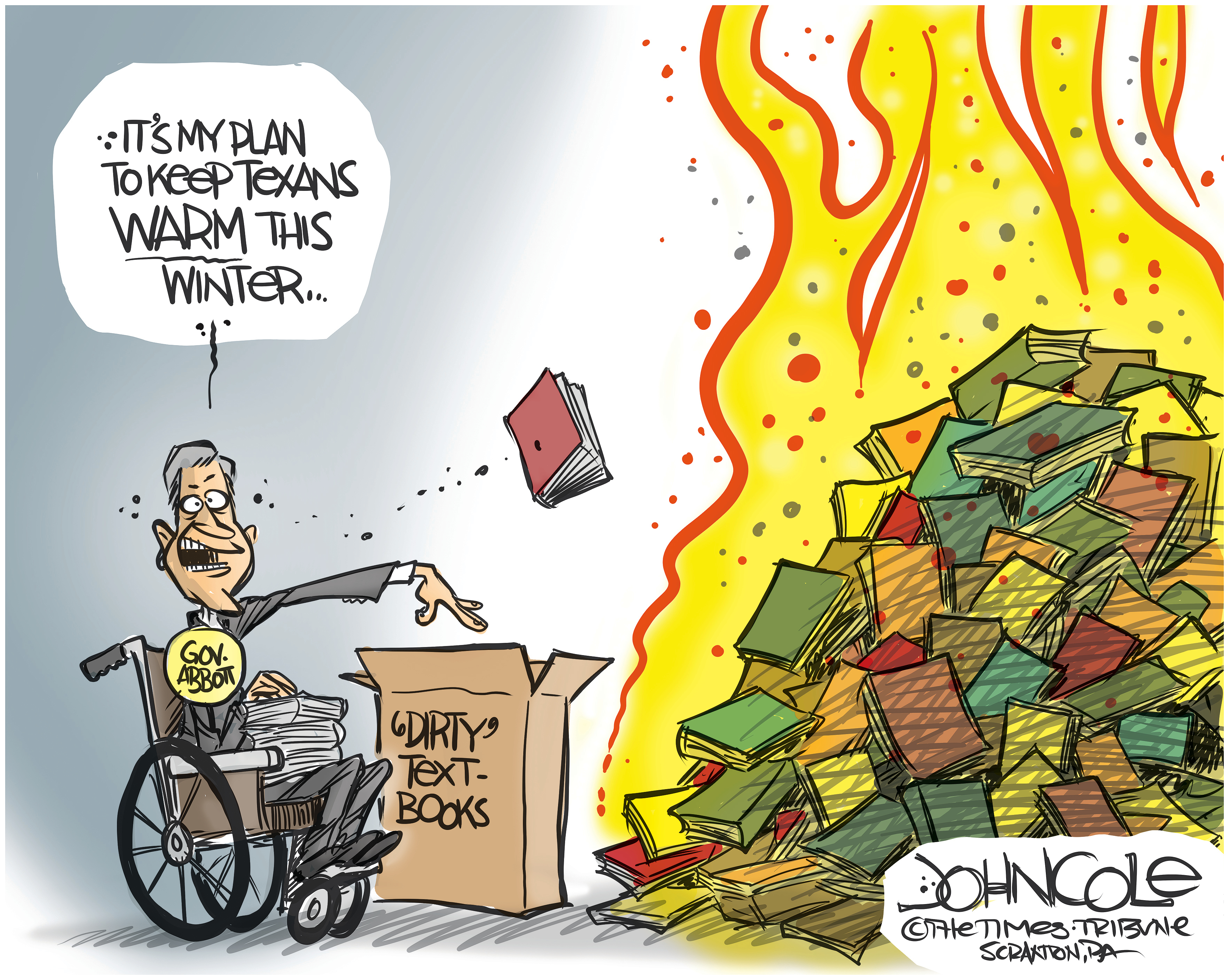
Me: (Reads a press release from the governor bashing local school districts because some of the books they have in their library and classrooms make some parents uncomfortable.) “Huh.”

My computer: Ding! (Another press release rolls in.)

Me: “Huh. So, I guess we’re gonna do this?”

Computer: Ding! (Yet another press release from the governor, this one accusing school libraries of stocking pornography.)

Me: “Oh. So we are gonna do this.”

This would have been a good year to observe National Banned Books Week. That’s usually the last week in September but I was galavanting across the Scottish Highlands sampling local Scotch while in search of the perfect Nat Geo travel photo (succeed with the one, not so much with the other) and I did Nazi this coming.

We’ve been here before. Back when I was in high school, parents wondered if books like To Kill a Mockingbird, Of Mice and Men and Brave New World were appropriate fare for teens. While they worried over those titles, we gleefully read The Lottery, Fahrenheit 451 and 1984 — books which now appear on most any modern list of banned or challenged books — and scoured the bookstore shelves for those other titles.

Back around the turn of the century (which now refers to the early 2000s, in case you, like me, still believe that 1984 was just couple of years ago), there was a small but vigorous movement to ban the Harry Potter books from many rural Texas schools. Because, of course, fictional magic = actual witchcraft.

Now we’re trying to ban from high school libraries books like The Handmaid’s Tale, The Bluest Eyes, V for Vendetta and (I kid you not), The Adventures of Huckleberry Fin.

With the exception of the Harry Potter series, every title I’ve mentioned here are STILL on some people’s radar as being inappropriate.

What the current raft of books that some parents want to burn — I mean, ban — have in common is that the subject matter deals with hard truths about racism, equality and gender identity. Come to think of it, every single title I’ve so far mentioned also deal with these things, but I get it that some parents don’t want to talk to their kids about these issues.

This has made recent news because some politicians, our governor included, are so concerned about a primary challenge that they quickly pander to the lowest common denominator in search of advantage.  I’d have a better opinion of our governor’s sincerity if it weren’t that many of these books have been on school library shelves for his entire tenure in public office.

I have three grown children. We never forbade them from reading anything they could get their hands on — and, in the case of the boy-child, were positively elated when he finally picked up the habit on the regular.

We possibly noted that he or she might be a bit young for a particular book, and I rolled my eyes so hard you could hear it across the street when the youngest picked up a humorous YA fantasy series whose pilot lines regularly involved elaborate puns.

But reading is a very personal thing. It opens minds to strange and wonderful new worlds. The act should be roundly encouraged. Even if the books prompt uncomfortable questions. Especially if they prompt those questions … yes, even if the narrative involves elaborate puns.

I’m not insensitive to parental concerns about content. I get it. But, we can’t shield our kids from the world forever (have you seen what’s on the internet?! The kids have!) and I’d posit that it isn’t in our teenage children’s best interest to even try.

Let them read. Let parents guide them, if they are so inclined. If they aren’t, let librarians and teachers (you know, the experts) do it.

But banning books from high school libraries because they raise uncomfortable truths or encourage teenagers to think for themselves has never worked out well for anyone.

“There is more than one way to burn a book. And the world is full of people running around with lit matches.”
— Ray Bradbury

“Where they burn books they will, in the end, burn people too.”
—  Salman Rushdie

“I know it when I see it, and … this is not that.”
— US Supreme Court Justice Potter Stewart

What’s an acceptable number?

There’s a question that rattles around my brain pan and the possible answers to it disappoint me.

How many is too many? What’s an acceptable mortality rate?

I was reminded this morning that I’m old enough to remember a time when the whole nation watched in trembling fear and hope as a group of workers struggled to save one little girl who had fallen down a well.

We are no longer that nation. Oh, we could probably muster enough empathy for a brief prayer but the actions many are taking today, right now, demonstrate that anything beyond that is hypocritical or wishful thinking.

There is a very large portion of our citizenry who just don’t care about anyone but themselves and maybe their own kids. They can’t bear minor inconveniences, even if that inconvenience could save a life.

“Don’t you dare force my kid to wear a mask at school,” they say, though some often use stronger language.

These people astroturf our school board meetings using words put in their mouths by agenda-driven groups and spread misinformation (I’ll be generous, here) and over-the-top threats should any trustee have the audacity to suggest anything more stringent than strong suggestions.

Their verbal assaults have stayed the hands of trustees across the state who want to do the right thing but lack the votes to actually do anything substantive to slow the spread of the virus through our schools.

If you think I’m guilty of hyperbole, tune in to Thursday’s meeting of the LISD school board. I’ve watched the last few meetings. It’s embarrassing.

Right now, Leander ISD leads the Central Texas region with more than 1,000 positive tests for the virus, far ahead of Round Rock’s 650. Right now, Leander ISD has 27 classes or entire grade levels on “remote conferencing” because too many of the children in those classes have been exposed to the virus.

Last week, Connely ISD closed down after two teachers died of COVID-19 infections and Austin Public Health reported the first child death from the virus.

What will it take for folks — especially those who are in charge of our kid’s safety — to take stronger action?

The death of a teacher (that actually happened last year, as I recall)? The death of a Kindergartner? Would that be enough?

Three deaths? Five?

What number of child COVID deaths is acceptable for school leaders and trustees to ignore the loud and obnoxious astro-turfing parents and Gov. Abbott’s toothless dictates and implement a no-opt-out mask mandate on our public school campuses?

Because, at the rate we’re going, every unvaccinated child in our public schools will have the opportunity to recover from this disease. Or not.

There’s a cynic in my brain that says that 20 child and seven teacher deaths aren’t enough to change some people’s minds. That’s how many elementary school kids and teachers were murdered at Sandy Hook. It didn’t change very many minds about unfettered access to guns.

A few deaths among Leander students probably won’t change very many minds about masks, either.

Like I said, I’m exhausted. And very disappointed.

Yep. People are eating livestock de-wormers. Don’t do that.

It’s true. People are eating a de-wormer, mostly intended for farm animals, to ward off or treat a Covid-19 infection and that’s prompted public health officials from across the state and the nation to issue a warning about it.

Last week, the Texas Department of State Health Services (DSHS) issued a warning that the improper use of ivermectin to treat or prevent COVID-19 infection by could lead to serious health complications and it doesn’t really help against the coronavirus. The Centers for Disease Control and the U.S. Food and Drug Administration issued similar warnings.

The Williamson County and Cities Health District posted the CDC warning to social media but said it doesn’t have any comments on ivermectin use in humans.

Despite these warnings, pharmacies and feed supply stores have seen a run on the product and the Texas Poison Control Center’s hotline is burning up with calls from people concerned about overdosing on the livestock dewormer.

According to the DSHS statement, calls to the Texas Poison Control Center about ivermectin exposure increased about 150% in August over the previous month.

“More than half of the 2021 calls (87, 55%) were potential Ivermectin exposure taken in an attempt to treat or prevent COVID-19,” according to the DSHS statement. “Most of the calls were about people experiencing mild symptoms, but for 52 (33%), the patient was either on the way to a health care facility or was referred to a health care facility, suggesting more severe effects.”

“Nausea, vomiting, and abdominal pain. However, you can have further problems, including mental status changes, coma, even seizures, and there have been deaths reported,” said Dr. Shawn Varney, the Medical Director of Texas Poison Center, reported in a Texas Public Radio Network story. “No, I haven’t seen any deaths here in Texas, but these are things that are reported by the manufacturer with people who use large doses.”

He said that the center has received 260 calls with ivermectin poisoning so far this year. He said the poisoning can be accumulative, so if a person takes multiple small doses over time, there can be a sudden overdose.

That hasn’t stopped a run on the product in area stores. One local chain pharmacy posted on social media Sunday that ivermectin was “officially on backorder, we do not have any.”

An internet search for the websites of WilCo feed stores also shows the product out of stock or on back order.

“The past few months it’s been ivermectin. Last year, it was hydroxychloroquine,” said Varney in reference to the drug used to treat malaria, lupus, and rheumatoid arthritis that was once touted to treat the coronavirus and was later proven ineffective and harmful in some cases. “What is it going to be next week? There’s something else will come along and will take its place. It’s part of the desperation for searching for a cure. But right now the best thing we have is the vaccine.”

There are formulations of ivermectin approved for human use, by prescription — for the treatment of head lice and some skin conditions, but ivermectin found in a feed store is formulated for animals.

“(The medications) have different carriers in them or different products to help get them in your blood stream.” said Varney in the radio interview. “They haven’t really been studied in humans either to know what the effect would be because they weren’t ever meant for humans. So there are different complications and problems that people may run into.”

“Ivermectin is not an anti-viral drug that can treat viral illnesses such as COVID-19,” said the DSHS warning. “The FDA has not approved ivermectin for treating or preventing COVID-19. Large doses of ivermectin can cause serious harm.”

Even the manufacturer of ivermectin warns against its use in humans.

According to the Merk website, “… company scientists continue to carefully examine the findings of all available and emerging studies of ivermectin for the treatment of COVID-19 for evidence of efficacy and safety.

The website noted that the company’s analysis has identified:
• No scientific basis for a potential therapeutic effect against COVID-19 from pre-clinical studies; 
• No meaningful evidence for clinical activity or clinical efficacy in patients with COVID-19 disease, and; 
• A concerning lack of safety data in the majority of studies.

“We do not believe that the data available support the safety and efficacy of ivermectin beyond the doses and populations indicated in the regulatory agency-approved prescribing information.”

“Let’s encourage the vaccine and avoid taking all these medications,” said Varney.