One of the most nonsensical things that has happened during this 18-months-long Covid nightmare, a nightmare positively brimming with deadly and nonsensical nonsense, is our governor’s most recent executive order.
A week ago or so, Gov. Greg Abbott used his emergency authority to prohibit any local government — including school districts — from doing much of anything to respond to the emergency.
This is truly counter-intuitive. The governor declared a public health emergency then, instead of enacting measures to address the emergency or enabling local governments to do so as local conditions warrant, he acted to make it all but impossible for anyone else to respond effectively to said public health emergency.
As you probably know by now, that executive order has spawned such a blizzard of lawsuits that it is difficult for anyone to know where we stand, what’s possible and what’s not. By the time this column appears in print, it is likely that the legal landscape will have shifted, then shifted again.
Confusion reigns and I’ve come to hold a feeling of abiding sympathy for anyone sitting on a school board right now.
I had intended to use this commentary to call out Williamson County Judge Bill Gravell for running away from this issue. School boards across the county could use a bit of help managing this crisis — and, make no mistake, with the number of campus Covid infections already skyrocketing, it is a crisis.
Gravell could follow the lead of county judges in the state’s most populous counties and take the heat off of school trustees by calling for campus-level masking requirements. In fact, it is my belief that he should do that very thing.
After all, Gravell has proven throughout this pandemic to have a good heart. Only the most recent example was an open letter to the community last week that showed his compassion, and his understanding of the depths of this problem.
But, similar to school trustees, Gravell finds himself between a rock and a very hard place. Many of those other county judges lead largely Democratic counties sympathetic to masking requirements for school-aged children. This is not the case in Williamson County. Many of Gravell’s partisans are actively hostile to anything that smacks of an effective pandemic mitigation strategy.
Indeed, I’ve heard that Gravell told one county department head that people would “burn down the courthouse” if he helped local school districts by pushing for masking requirements.
(Editor’s note: This is a second or third-hand report and I’ve not tried to confirm it … but, given the belligerence I’ve witnessed at commissioners court, I would be surprised at neither his sentiment nor the predicted response. There are some bat$h*t crazy people living in Williamson County.)
So, while I wish that our county judge had displayed more courage, I can’t say I blame him for his well-intended but otherwise milk-toast response.
Which leads me back to our governor.
It wasn’t that long ago that Republicans were staunch in their support of local control. Over the last decade or so, that support has morphed into … something else, mostly a philosophy that “local control” is good but only when local governments do what the state wants them to do.
It reminds me of Fezik’s line from The Princess Bride: “I do not think that means what you think it means.”
I reference this because, to our current crop of top state officials, “local control” really has more to do with the state’s relationship with the federal government, not very much at all to do with the state’s relationship to cities, counties and school boards.
In other words, to these people, “local control” is just another way to assert “state’s rights.” You may take whatever meaning from that you wish.
Our kids — and the people responsible for their safety — don’t need our governor to engage in divisive political theater. They need a governor who follows public health science and who remembers that the most important level of government is that which is closest to the people.
The next few weeks will see the end of the second season of the Ragged Edge podcast … and, it bids fair to be an eventful few weeks. I gotta tell you, I’m excited about what we’re about to do.
On Thursday, June 10, the Ragged Edge will go on the road again for a live conversation with State Rep. James Talarico (HD52). We’ll be at the Texas Beer Co. in Taylor and the program kicks off at 7 p.m. (or so).
Be sure to stop by for the second live event of our brief existence, the second time we’ve interviewed Talarico this year and the third time I’ve sat him down on the orange directors chairs on the Texas Beer Co. stage.
But wait … the very next week, I’ll MC a live, in person town hall event with State Rep. John Bucy (HD136) sponsored by The Hill Country News and hosted by Whitestone Brewery in Cedar Park. That event will also begin at about 7 p.m. (June 17).
Here’s a treat for all of you who have followed and (financially) supported our work at HCN this last year and a half or so … stop by the table at the entrance to the patio, get a ticket from our very own Kirsten Foltz, and get your first Whitestone beer for only one dollar!
This will be my second live interview with Bucy, the third overall.
Both interviews will drop as podcasts the following afternoons (June 11 and 18, respectively) so, if you can’t make it to either live event, you can still listen in to see what the two state representatives feel about the recently concluded, somewhat crappy, 87th session of the Texas Legislature.
But wait, there’s more!
Our friend Jason Stanford just published a book, with two co-authors, called “Forget the Alamo!” He and I will talk about that book, the conclusions it draws (spoiler alert: it ain’t pretty where it comes to how we teach Texas history, particularly about those 13 fateful days in March 1836) and probably talk about how the enduring Heroic Anglo Narrative echoed throughout the Texas House chambers during the most recent meeting of the Texas Legislature (James Talarico’s politely brutal mic drop on Rep. Steve Thoth is worth a review and is germane).
I just finished it and can tell you that it’s something of a bombshell. It’ll be published June 9 (I think) by Penguin Books. That podcast will drop June 25.
Finally, sometime around the first of July, I’ll sit down with representatives from K-9s for Warriors, a group out of Florida that pairs military vets with service dogs. I’m proud to say that my friends at the Texas Beer Co. have brewed up a delicious lager especially for a fundraiser for this group and they’ve hooked me up with representatives and, possibly, a few vets willing to share their stories.
You know what? That conversation could very well be live as well … but we’re still locking down the details.
Once we get these four episodes in the books, it’s likely we’ll take a hiatus for a bit. It’s been a grueling year or so and I need a break. Plus, if all goes well, we’ll be on vacation the first two or three weeks of August …
So, join us for this wild ride in June. You can find all our podcasts here, on @applepodcast, @spotify (rate and comment … that stuff helps others to find it) … and you can find details about live events and future episodes on our Facebook page here.
There’s a weird feeling that washes over me when the community my newspaper serves is name-checked — unfavorably — in the national media.
It hasn’t happened very often. There was that time a county sheriff got caught “seeding” a field prior to a dove hunt that was also a campaign event. Oh, wait … that was a nine-day wonder, but it didn’t make the state or national news.
Then there was a train wreck involving a train carrying Astros fans that killed a couple of kids. Huh. That one didn’t break through the noise, either.
Oh, and let’s not forget …
Come to think of it, it hasn’t happened very often at all, if ever.
Indeed, it has happened more frequently and with more histrionics during my relatively brief tenure at the Hill Country Newsthan at any time in my 30-plus year career.
(Y’all remember my repeated admonition that this stuff ain’t normal? It’s not, but it appears that some of you have forgotten. PLEASE STOP making our communities look like it’s full of bigots. I’m semi-retired and too old for this stuff!)
National name-checking is even worse when one of the people doing that name-check is a favorite author. That’s happened twice, now. At least twice. I may have missed one or two.
This time, thankfully, it’s not a handful of rogue city council members trying to leverage support for divisive and controversial issues into some sort of distasteful regional or national notoriety. It’s not, but it seems like some of the same attitudes that launched Cedar Park and Leander into the spotlight a couple of years back are still around.
No. This time, one of my favorite authors has the Leander school district in her cross hairs.
I stumbled across an open letter that was sent to Leander trustees about the book club reading list.
The letter took trustees to task for removing some books it deemed too controversial for high schoolers to read.
Here’s an excerpt: “We are particularly alarmed and disappointed to see that so many of these targeted books feature authors or characters who are women, LGBTQIA+ individuals, or people of color … [and] are deeply concerned that this entire episode risks sending a dangerous message to students: that the best way to confront ideas or literature with which one disagrees is to prohibit or silence it, rather than finding other, constructive ways to engage with it. ”
The first name on the very long list of authors who signed this letter was Margret Atwood, author of the brilliant dystopian novel, “The Handmaid’s Tale.”
Separately, another author, Carmen Maria Machado, who wrote “In the Dream House, published a column in the New York Times. She noted that “… preventing children from reading my book, or any book, won’t protect them. On the contrary, it may rob them of ways to understand the world they’ll encounter, or even the lives they’re already living.”
It was her work that prompted a woman to brandish garishly colored sex toys at Leander ISD trustees.
Now, I am painfully aware that this issue continues to ricochet across social media and that shines a rather harsh light on our community’s bigotry and hatefulness. Our most recent story about this has spawned more than 400 comments, many of them using language I would never use in front of my mother.
I am also aware that the simple act of bringing this up will expose me and this newspaper to more hateful rhetoric. But, this discussion isn’t useful if we continue to yell past each other rather than talking to each other.
All of my kids are readers. All of them read pretty much whatever they pleased — mostly age-appropriate stuff but also books that pushed their personal boundaries and challenged their worldview. We were thrilled to see them reading fiction, for pleasure.
I don’t really have a point, but I do have two observations, and they are these:
• My mother-in-law, a life-long public school teacher, warned that challenging the creativity of teenagers is a foolish and dangerous obsession (a spider tattooed across the face of a child in defiance of a school dress code was part of the conversation).
• A good friend, who is involved in politics at the state level, routinely warns us to be very careful what we say, and the way you say it, on social media. Potential businesses pay close attention to that stuff. Often, the intelligence gleaned from these posts is used to determine whether or not to make expensive investments in a community. Ready bigotry and hate will send investors scrambling.
Finally, here’s another quote from Machado’s NYT piece: “They want to shield their children from anything that suggests a world beyond their narrow perception. As anyone can tell you — as history can tell you — this is ultimately a fool’s errand.”
This commentary was first published in the Hill Country News.
… or, how I kinda-sortalearned to love craft beers
— • —
NOTE: This feature story was first published in the Winter 2018 issue of Taylor 76574. It was one of my favorite feature stories written while I was at the Taylor Press but I couldn’t find it anywhere so I decided to post it here — along with the photos I took — as a way to preserve it.
— • —
“He is a wise man who invented beer.” – Plato
“Beer is proof that God loves us and wants us to be happy.” — Possibly Anonymous; often (mistakenly) attributed to Benjamin Franklin
— • —
Taylor and beer go hand in hand. I suppose it has to do with our Czech/farming heritage but there is no question that many people in Taylor and East WilCo like the occasional beer.
I do too. I used to believe I was a bit of a sophisticate when it came to beer, since I drank Shiner Bock before it was cool. I also drank Lone Star longnecks back then, before hipsters “discovered” them. Later, I switched to Dos Equis.
Once the craft beer renaissance came to Texas, my beer drinking habits were no longer cool. The taste of those beers lacked the crispness I anticipated. They could be unexpectedly bitter or sour, off-putting. I tried. I did. But I decided those beers weren’t for me.
Then, Taylor got its own craft beer place and, suddenly, my ignorance took on an economic imperative. Plus, the bartender at that new taproom developed a tick that showed up whenever I asked for “the closest thing you’ve got to a Dos Equis.” That, and the rising local interest in craft beer, is the impetus for this article, so I plotted a tour of Williamson County brew pubs.
I reached out to a couple of friends: Ken Cooke, the former publisher of the Rockdale Reporter who now publishes the paper in Fredericksburg, and Lee Nichols, the former beer editor at the Austin Chronicle and the San Antonio Current (yes, there is such a thing as a “beer editor” — or used to be).
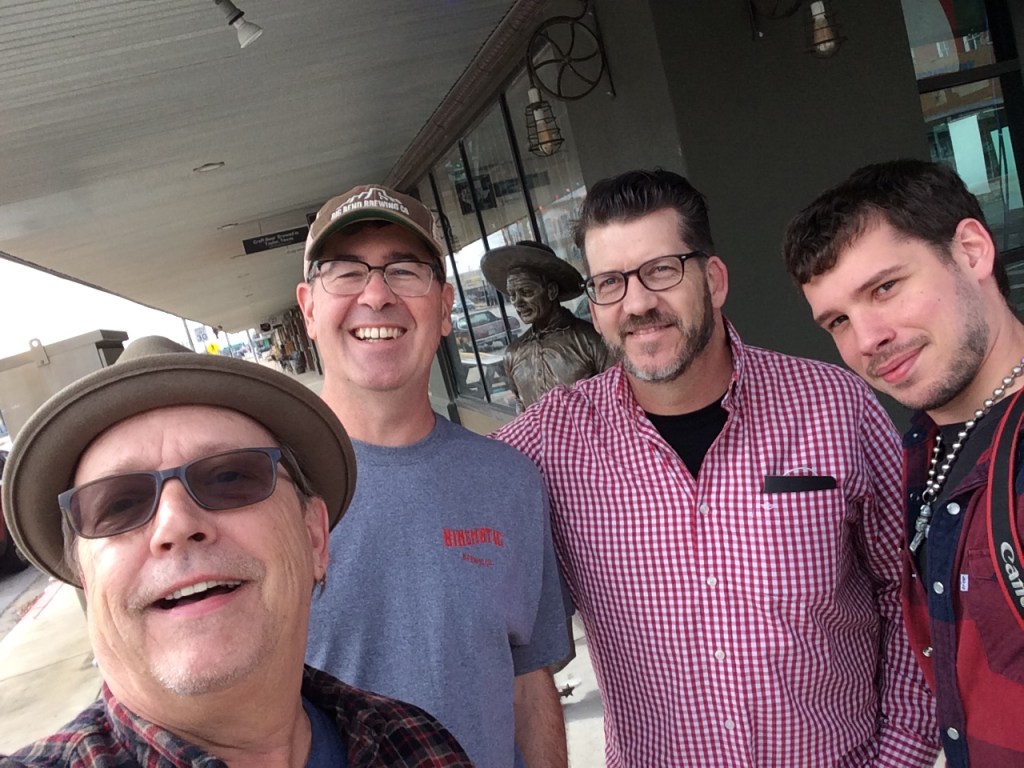
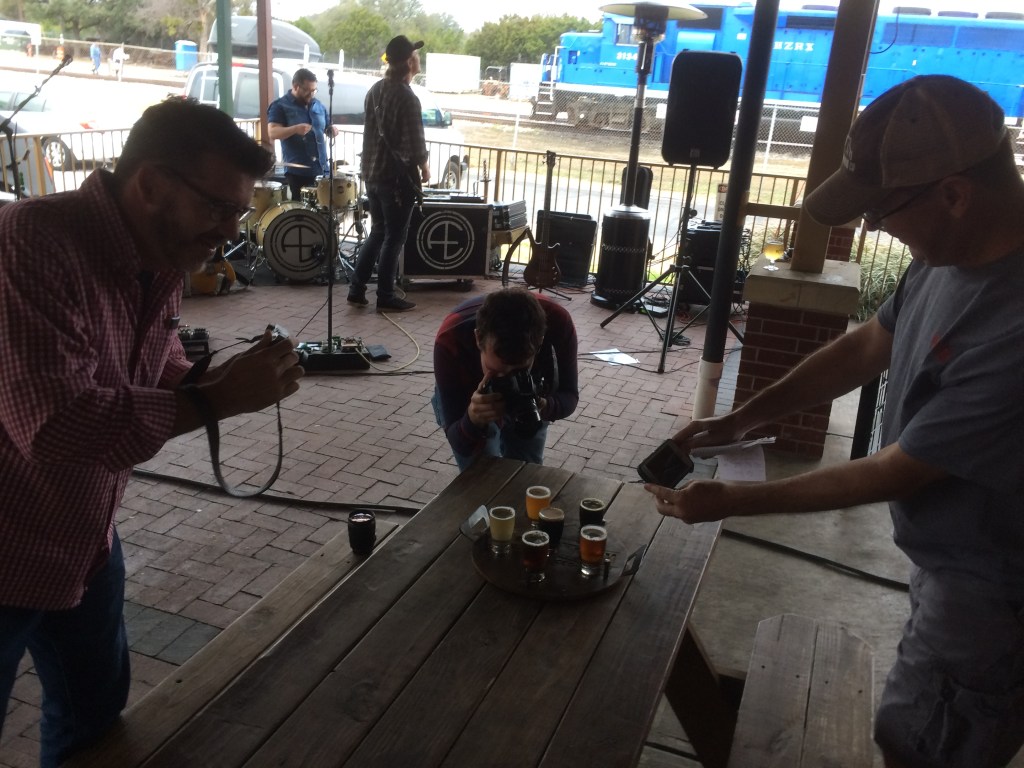
(R-L) The author, Lee Nichols, Ken Cooke and Matt the Photographer prepare for a WilCo pub crawl on a chilly Saturday in January, 2018.
Our mission: visit as many of the breweries in Williamson County as time and inebriation would allow. We intended to sample only the beers that particular place brewed. At each stop, we would buy a sampler of four or five beers, share that sampler and make a report.
— • —
We met at the Texas Beer Company’s taproom.
Dylan, our driver for the day, loaded us, along with Matt the Photographer, into a big, shiny black Tahoe for the trip to our first stop in Granger. The Tahoe was courtesy of Cynthia Karkoska of Cynthia’s Manhattan Limousine, who learned of our impending pub crawl and decided that three grown men loose on the highways and back roads of Williamson County on a pub crawl was a remarkably bad idea. I agreed.
We could have been mistaken for slumming but well-heeled tourists or, maybe even covert government operatives. The Tahoe and driver lent that kind of undercover air to our mission.
On the road to Granger, I explained my lack of beer knowledge.
“That’s your training-wheels beer,” Lee chuckled when I told him I preferred a Mexican lager to most any craft beer. “Everyone has a training-wheels beer.”
— • —
Granger City Brewing Company is a 30-barrel pub with a handful of beers on tap. It’s sort of a dive but perfect for Granger. Think Ed’s Place rather than the Texas Beer Co.
The ale was unsurprising but good. I liked the Winterfest — just a wee bit stronger than the golden ale — but I was terrified of the porter.
I grimaced at my first taste. Lee took a sip and said it was interesting. “Most porters have a strong chocolate flavor. This doesn’t. It’s very smooth.”
Once we made it safely to Granger, as our resident Craft Beer Guru, Lee immediately took charge of our education.
I took another tentative taste, then a swallow.
No chocolate but it had a deep roasted flavor that, once I opened my mind and taste buds, did have a velvety smoothness that reminded me of a particularly good cabernet.
I decided to keep an open mind.
— • —
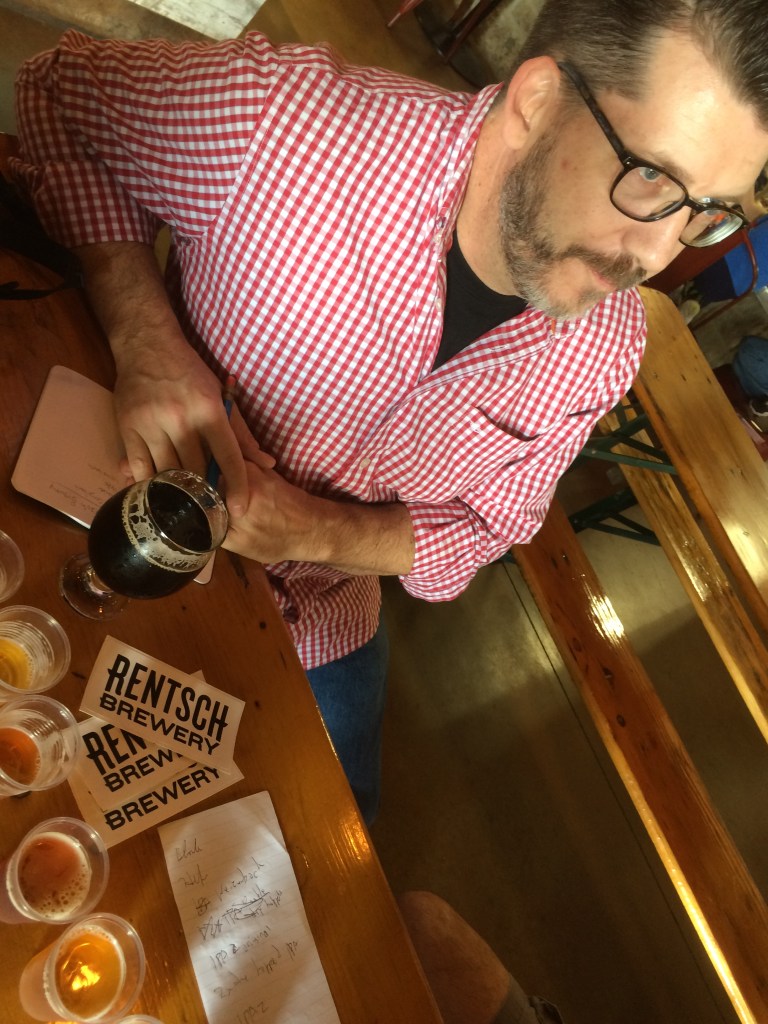
Ken went off the rails at our next stop, the Rentch Brewery in Georgetown. The bartender drew samples of five or six beers, among them a Russian Imperial Stout.
We sat down to work but Ken sidled back to the bar.
“What?” he asked when he returned bearing an 8-ounce glass brimming with a foamy, sinister, deep brown liquid. “I’ve never met an Imperial Stout I didn’t like.”
Ken ran off the rails early. Listing ensued.
“I’d say, right about now, you’re screwing up,” said Lee with a laugh. “This is a marathon, buddy, and in mile three you suddenly decided to go into a full sprint.”
The stout boasted an alcohol content of 12 percent.
“That’s violating rule number one. Don’t go for anything higher than about 6 or 7 percent alcohol when you’re doing a pub crawl,” said Lee. “I’d go to that at the end of the day.”
Saving the stout for last, I tried the Hefeweizen. It was … interesting. And a little sweet.
“You might be picking up a little banana flavor,” said Lee. “That’s because of the yeast in brewing.”
Then, I faced the first IPA (India Pale Ale, but in the American style) on the tour. Nearly everyone I know who purports to appreciate craft beer seems to gravitate to an IPA of some sort.
“You like whisky, right?” Lee asked. “I think you could really learn how to like IPA. It’s the same thing. Because of the extra hops, it’s all about learning how to like bitterness.”
So, hops in beer equals peat in Scotch. Got it.
I sampled their Double IPA.
“It’s a little grassy,” I wrinkled my nose. Not unpleasant. The taste of newly mown hay, maybe?
“That’s the double dry hops,” Lee explained. “Normally, the hops are boiled into it. For the double, you have some extra hops — might be different hops — and then run the beer right through it.”
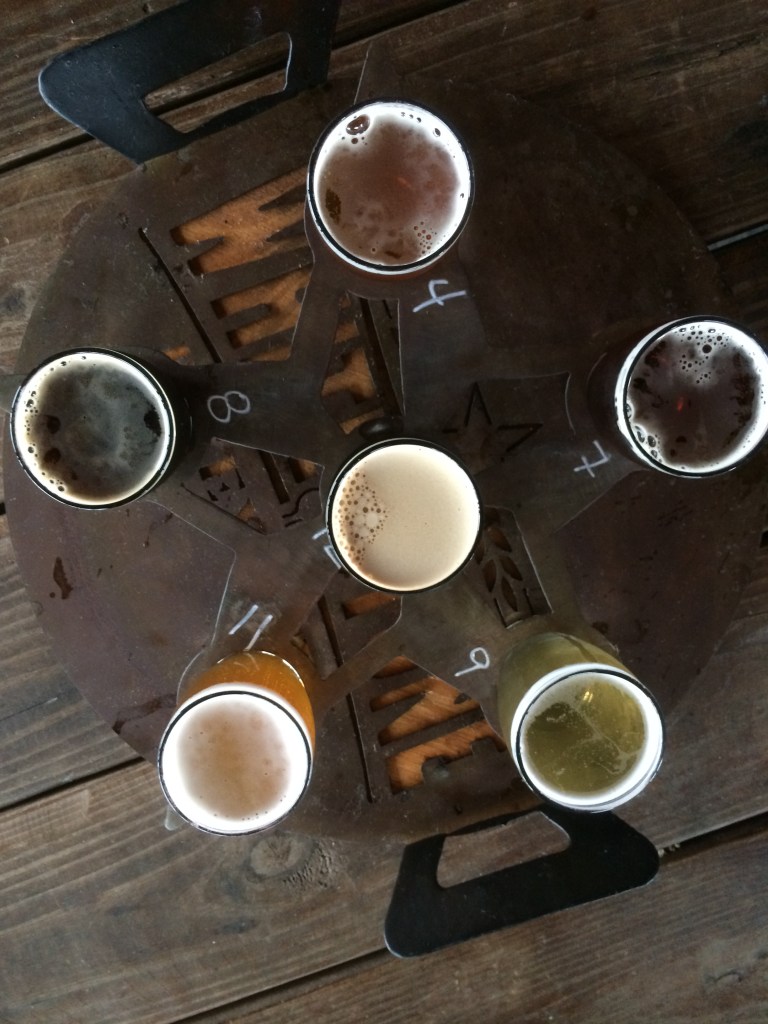
Beer flight and tasting notes.
Finally, we came to the Russian Imperial Stout. Ken had begun to list a bit from his own half-pint.
“Here’s the plunge off the deep end,” Lee announced and he picked up the plastic cup in salute. He knocked back a swallow. “Wow. You’ll either hate it or love it. It’s a strong flavor.”
Compared to the porter we had in Granger, it was bitter and very chocolate forward.
“This is aged in bourbon barrels,” said Lee. “That’s what you’re really tasting. A Russian Imperial Stout has some pretty strong flavors anyway but, when you age it in bourbon barrels, it’s like taking a baseball bat to your mouth.”
What a metaphor. I neither hated nor loved it. Still acquiring the taste.
— • —
We learned an important pub crawl technique at Red Horn Coffee House and Brewing Company in Cedar Park.
“Oh, this is the brisket beer. You should try that last,” said Lee examining Red Horn’s offerings. “Start with the three in the middle because the others will have a stronger flavor. Sample those last, just so you don’t wreck your taste buds.”
Right. The lighter beers first. The deadly porters and stouts last.
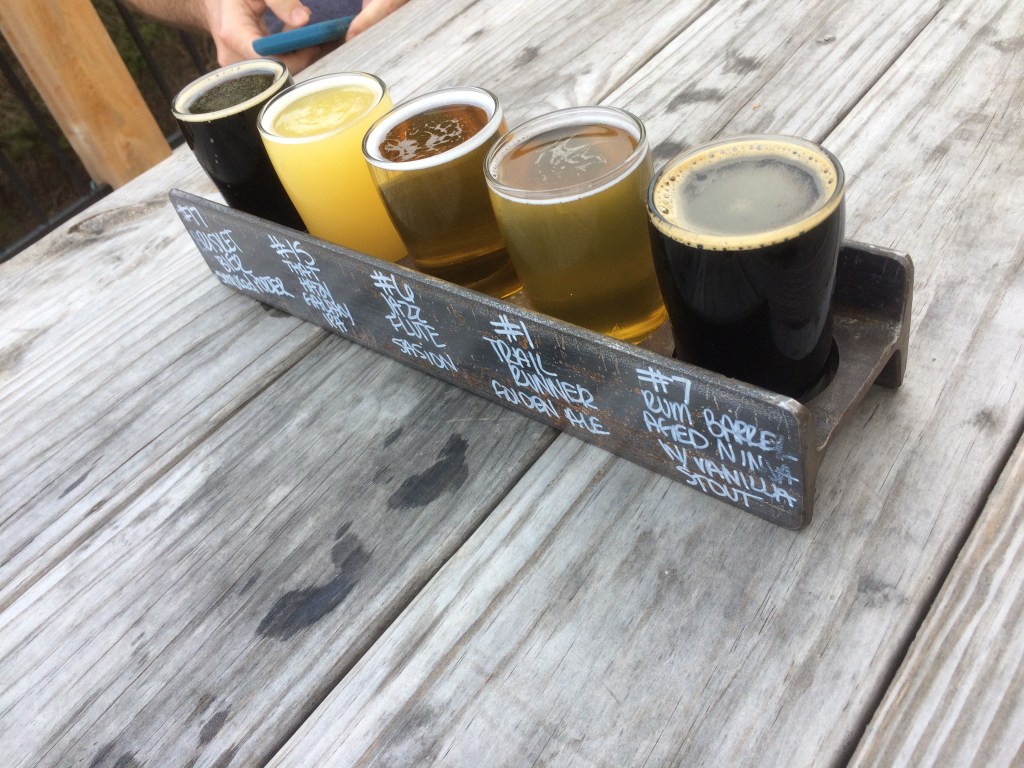
The three beers in the middle were an IPA, a golden ale and a farmhouse saison. The two on the ends were a vanilla stout and something called a Brisket Porter. We’d asked for the last because, well, Taylor.
A flight of beers at Redhorn included … brisket beer?
We sampled and commented on those three — and all three had unexpected flavor profiles.
The IPA was sweeter than anyone expected, with a strong grapefruit flavor. The stout tasted of rum and vanilla. The ale was clean and crisp.
“So, are we gonna make Richard be the crash test dummy?” asked Mat the Photographer, pointing at the Brisket Porter.
“Don’t call your boss a dummy,” joked Ken as he tossed back the last of the IPA. Not without a bit of trepidation, we all sampled the Brisket Porter.
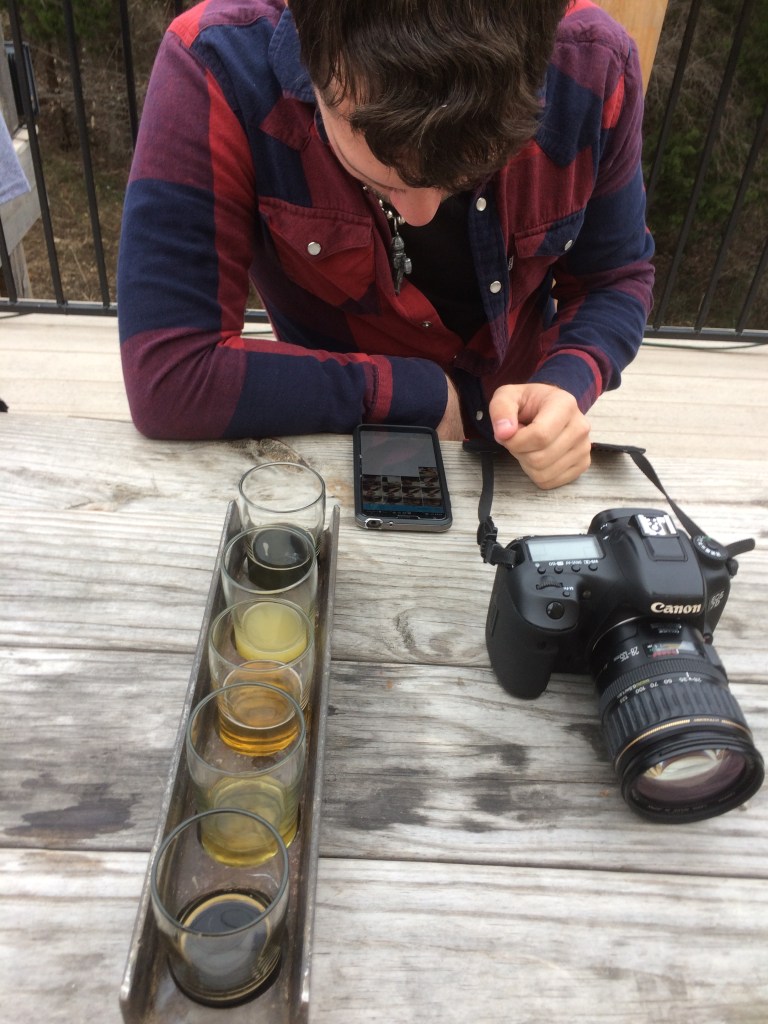
Matt the Photographer checks out some of the photos he’d taken during the day … before calling his boss a dummy.
“This is probably a rauch beer,” said Lee after a hearty swallow. “It does not actually taste like brisket.”
I disagreed. It tasted like someone brewed up a barrel of port then soaked it in a batch of Wayne Mueller’s burnt brisket ends.
“Definitely a brisket overtone to it,” Ken allowed.
“The malt is smoked,” Lee explained. “That’s what gives this a smoky flavor.”
— • —
Our next stop was the Whitestone Brewery, where we learned another important bit of beer trivia: it’s something of a tradition that certain craft bock beers should have a name that ends in “ator.” As in Bockanator.
“Gives it that Schwarzenneger feel,” joked Ken.
We also learned that dark beers — stouts, porters and certain bocks — don’t need to be ice-cold. In fact, as they are winter beers, they shouldn’t be too cold at all, nor are they really intended to be consumed in the summer.
“I never ever recommend you drink a doffelbock (double bock) in the summer,” Lee opined. “It will make your mouth feel like it’s full of cotton. It is a winter beer.”
Whitestone’s offerings.
We tried a few summer beers.
The Berlierweiss, a sour beer, tasted like a good dry chardonnay. Almost champagne.
“This would be much better in the summer, and if I wasn’t sitting here shivering,” he said. “Why didn’t you tell me to bring a jacket?”
“You brought a jacket,” Ken answered. “You left it in the car.”
Everyone’s a photographer.
— • —
During our stop at Whitestone, we carved a few breweries from our itinerary as the day was getting long.
We headed to Idle Vine Brewery in Cedar Park, only to learn it was celebrating its first anniversary. The line into the taproom snaked out of the double freight doors and around the building.
A tent outside sold canned versions of their brew so, while waiting for Dylan the Driver to make the block, we tried their IPA. The others liked it. I’ve yet to acquire the taste.
We jumped over to Bluebonnet Beer Company in Round Rock. Frankly, by this point, my ability to distinguish between the brews I’d sampled earlier in the day to those served up by Bluebonnet had paled. They all seemed just fine, though Ken and Lee pronounced them quite good.
— • —
Finally, back to Taylor and the Texas Beer Company.
We sample their IPA, porter, blonde and amber beers.
A team from Davis BBQ had set up sandwich-makings on the counter. The brisket sandwiches were a welcome addition to our bellies.
Ken said he really dug the amber. I sampled the blonde and, finally, discovered why I haven’t taken to it like I expected — hops.
“It’s a hoppy blonde,” said Lee, wiping a scud of foam from his lips. “It’s a bit hoppier than most blondes but I like it.”
Then, we sampled the porter.
“That has good flavor,” said Ken. “A little bit of chocolate, but not a lot. Very good.”
True to his instructions, Lee closed out the tour with a glass of the King Grackle Stout.
“Ohhhh, that’s good,” he sighed. “This may be the best beer of the day.”
Back when he was our attorney general, Greg Abbott searched high and low for evidence of voter fraud.
This would have been about a decade ago, when the Texas Legislature needed to gin up support for voter ID, their newly-minted voter suppression technique.
At the time, Abbot was only able to come up with a handful of prosecutable voter fraud cases, and those examples were scattered throughout five or six statewide elections. Out of the millions upon millions of votes cast in the half-dozen or so elections Abbott canvassed, there wasn’t enough in-person voting irregularities to warrant much of anything, including the effort he devoted to the endeavor.
The take-away from that effort was — at least for me — the Texas GOP had this solution that they really liked (because it appealed to the anti-immigrant fervor infecting the GOP) and were in search of a problem for it to solve.
The lack of a problem did not deter them from enacting one of the most draconian voter ID laws in the land.
Fast forward about a decade and you can see that Texas Republicans are still looking for a problem for their restrictive election policies to solve, despite there being no evidence of an actual problem.
According to the Houston Chronicle, our current AG, Ken Paxton, released his team to uncover all of the irregularities he was certain would be found in the 2020 election. What with all the mail in votes, the massive early voting turnout, the drive-thru voting … all that, surely prosecutable mistakes were made.
After devoting 22,000 man-hours to the search, they came up with 12. Not 12 fraudulent votes, 12 “irregularities” like inconsistent addresses or similar typographical issues.
In other words, it was a clean, fair and secure election.
“This is not a crisis that impacts the outcome of our elections, like they are being portrayed,” Rep. John Bucy told me when we sat down to talk about this issue last week. Bucy, who is our State Representative, sits on the Elections Committee in the Texas House and has filed about 20 bills that would make it easier to cast a ballot in Texas. “This is a political game. It has nothing to do with election integrity.”
But, as in the past, the lack of actual voter fraud isn’t stopping Texas Republicans — who’ve held every lever of state government for 20 years — from imposing its will on the electorate.
There are two bills making their way through the Texas Legislature, one in the House and a companion in the Senate. If passed into law (and, is there any question that Republicans will pass them?), they would (among other things) make it harder to help someone register to vote, limit early voting, forbid drive-through voting after hours voting, make it harder to drive your elderly mother to the polls and, in a weird turn that will likely put Texas Republicans on every doctor’s “do not resuscitate” list, require an actual doctor’s excuse if you want to vote by mail because you have a disability.
As is true of every single election integrity policy they favor, these measures will have a profound impact on people of color, rural Texans, working poor, students and the elderly.
As a Washington Post editorial put it last week, Texas Republicans are almost surgical in their cynicism when it comes to “protecting” the vote.
Bucy had words about that cynicism.
“If this state is as conservative as they say, why don’t they want everyone to vote and just prove it?” he demanded. “We had an election that the Secretary of State said was a success, smooth and secure. We had the best turnout in 29 years. What problem are we fixing? And, let it be known, they still control all levels of government. So, even though we had more people participate, it’s not like the Democrats took over. We had more participation … and it led to them still holding their power so I’m not sure what problem they’re correcting.”
I have an answer, Rep. Bucy. Great swaths of Texas are tinging purple, if not blue (a glance at the voting trends of south Williamson County will demonstrate this) and that they barely escaped the 2020 election with their hides intact.
So, to them, election integrity means that their voters are favored over other voters.
Oh, right. I get it. The solution in search of a problem? We found the problem and it’s that too many of the other voters are voting.
Richard Stone hosts an independent politics and current events podcast called The Ragged Edge. The podcast is available on Apple Podcasts, Spotify, Google and other popular podcast servers. You can hear the entire conversation with Rep. John Bucy on the most recent upload or at raggededge.buzzsprout.com.
This column was also published in The Hill Country News.
A Letter from Williamson County, Texas: Winter, 2021
Dearest Cousin,
The experience washing dishes in a gallon of tepid snowmelt was less than satisfactory. I fear we may perish of some vile illness induced by the crusted and rotted scraps of food we were unable to remove from the silverware.
We returned to the back 40 to fetch more snow. We were required to chop through a thick rind of ice before we could harvest the snow underneath. It was cold and wretched labor. Two gallons of snow renders barely two quarts of water. I dread the effort but Poo Pourri can do only so much. We must flush the toilets today!
Alas! The good whisky will not outlast the freeze but I discovered a partial bottle of cheap Irish in the recesses of the cupboard. We will persevere.
Please inform me of your situation, and assure us of the health and safety of you and yours.
Your Cousin
I took a shower this morning. It was the second day in a row that I did so and I felt a bit guilty, but only a bit.
Like a lot of you, we didn’t have running water for much of last week. We still can’t drink it but we can bathe, and wash dishes and clothes. This is important because it means that none of the water pipes in this 100-year old house burst during the freeze. It also means that we had power to heat the water — another luxury we were denied for much of last week.
Let’s not even talk about the trauma inflicted by the lack of internet service.
I must admit that standing under a stream of hot water was delicious and more than a little indulgent.
It almost let me forget about last week. Almost.
But, I didn’t forget about it, nor my white-hot anger that citizens of the most energy rich state in the most advanced country in the world had to endure a killing freeze without electricity and, for all too many of us, water.
Friends, you’ve already heard our elected leaders, along with legions of keyboard commandos, try to pin this debacle on the Electric Reliability Council of Texas (ERCOT). That’s the private non-profit group in Taylor that manages our electric grid.
It’s a red herring. Our elected leaders are, once again, trying to avoid accountability. Many ERCOT heads will roll, for sure, and some probably deserve it, but the system is flawed … and ERCOT is toothless. It has no authority to regulate energy providers. None. All ERCOT can do is “suggest” measures.
The problem we faced last week is a structural issue. It’s not just a matter of winterizing natural gas lines or resurrecting a few coal-fired plants, or putting anti-freeze equipment on some wind turbines, though all of this will help.
Our energy system was built by the Texas Legislature in the late 1990s, fueled by oil lobby money, around an Enron pipe dream designed to maximize profits, disincentivize reinvestment, and avoid regulation and consumer protections.
Yes. That Enron. Even after Enron went down, our legislators deregulated in 2002. Because, oil company profits and, I suppose, freedom.
If you don’t remember Enron, Google it. It’s horrifying, one of the worst examples of capitalistic excess you’ll ever run across. The Wolf of Wall Street was a piker compared to those pirates.
Another good source of information is the autopsy of the 2011 storm. You know, the storm that showed our lawmakers — the only people who can regulate our energy market — that what we faced last week was not that far fetched.
That report is dry but the bare handful of providers who took that it to heart run the some of power plants who carried the load Monday and Tuesday. They just couldn’t produce enough juice to carry the entire load. The recommendations begin on page 195 and run about 100 pages.
Yeah, blame game won’t help because the very people who put this into motion are the only ones who can fix it, if they will. Sadly, the Texas Legislature has a poor track record of investigating itself.
In many ways, what we saw this week is a feature of our energy market, not a bug.
And, let’s just put this out there … because of our deregulated market, many people in Texas will face electric bills in the thousands, even though they had no electricity for much of the week.
This is ALSO a feature, not a bug.
My most recent podcast, in which I interviewed State Rep. James Talarico, dealt with this issue. You can find it, and all our previous episodes, on Apple Podcasts, Stitcher, Spotify, Google Podcasts and iHeart Radio … or, at this link.
Perhaps it’s best that I write this today rather than last week when my outrage meter was pegged at 11 and I was so put out with Williamson County that I was literally red in the face.
If you’ve tried to get a coronavirus vaccine, you know that the process can seem random and arbitrary. And difficult. Getting through to the county’s vaccine help line can seem pretty random, too. Getting registered on the proper website can also seem pretty random.
A note to me from an 80-year old Cedar Park couple, desperate to get on a waiting list — any wait list — focused my ire, as did the lack of useful response from every single county official to whom I reached out for help.
I lost some sleep Thursday worrying about that couple.
I know how difficult this is but we’ve had months to prepare. We knew back in December that there wouldn’t be enough of the vaccine to go around. What did they think would happen when the vaccine was released to people other than first responders and frontline medical personnel? If they didn’t expect thousands upon thousands of people logging on to wait list websites or calling the vaccine hotline every day, what were they thinking?
Then, I remembered. Right before Christmas, Gov. Greg Abbott and his advisors abruptly opened vaccinations to those of us who are in Phase 1B because they misread the data and accused hospitals and pharmacies of letting doses of the vaccine languish on their shelves.
They were wrong, of course, but the governor couldn’t (or wouldn’t) walk it back. Vaccines weren’t going unused. There was a massive lag in the data — largely because providers had trouble with the creaky software the state used to track vaccinations — and every dose on a pharmacy shelf was committed.
But, that opened the floodgate and local officials dutifully amplified the governor’s decree that those of us who fell into Phase 1B should call their pharmacy or their doctors and get a shot before the vaccines expired.
I got a copy of the vaccine allocation list and began calling around, just to see who had doses to spare. The general reply was something along the lines of, “What?!”
I relayed that response to the county health department and they confirmed that no local health care provider had excess vaccines. They were as confused as I.
With his sudden announcement, the governor botched any hope that local officials and hospitals would have the ability to stand up a glitch-free vaccination rollout.
Like many of you, I put myself on every waiting list I could find, and forwarded links for those lists to my 80-some year old mom.
It all seems pretty random. It is pretty random.
I’ve been told that, as chaotic as WilCo’s response appears from this end, it is (or was) absolute madness behind the scenes. How many times did you call the vaccine help line last week before a live human being answered the phone? I called 30 times over three days.
I contacted that Cedar Park couple on Friday. Some friends had helped them get an appointment for the vaccine on Saturday through Austin Public Health. They reported to me on Sunday that they had indeed gotten their first doses of vaccine.
Pretty random but, whew.
I don’t think my mom has her appointment yet but our local provider called me and my wife Thursday and offered us a pair of doses. They had a limited number and some people failed to keep their appointment.
Again, pretty random. We just happened to be in the position we could dash over to the doctor’s office in time to snap up a couple of unclaimed doses.
I remain frustrated by this mess. There is not enough vaccine to go around and our priorities are a bit skewed — neither that 80 year old couple nor my mother should lack vaccinations, and the fact that essential groups like teachers and grocery store clerks can’t even get in line is reprehensible.
But, that’s not all the county’s fault. I can fault them for muddied communications — and that aspect of the county’s response has been all over the map — and not having a plan to register its residents but, in all fairness, the state put the county in a deep hole from the outset.
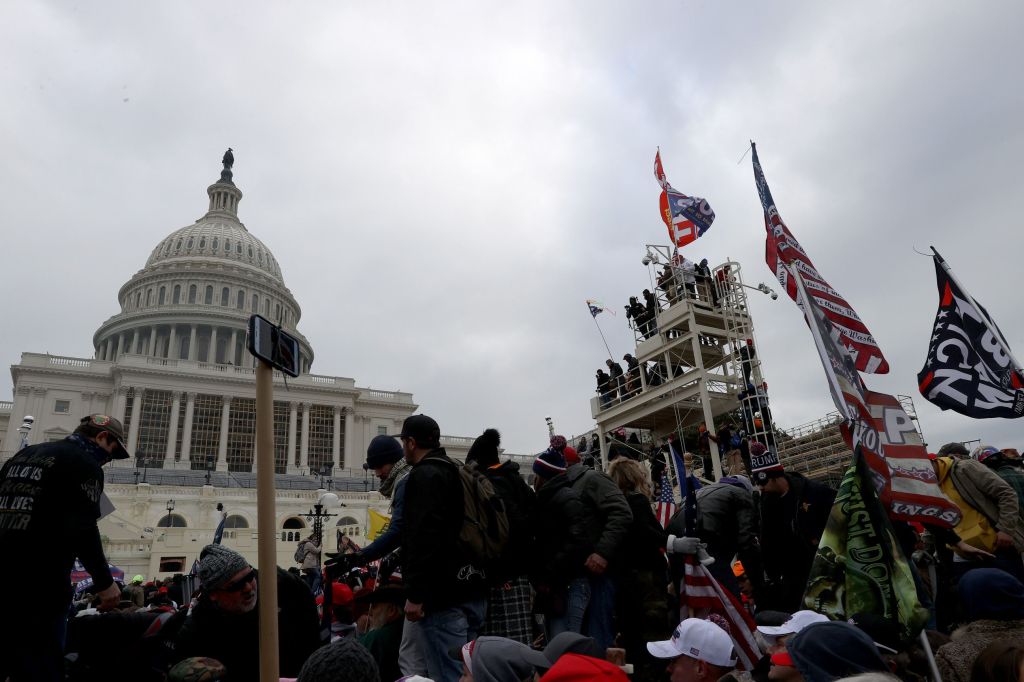
Trump rioters stormed the Capital on Jan. 6. Photo courtesy Tribune News Service.
Calls for unity, after 147 members of the U.S. Congress tried to overturn the election, after they amplified the very lies that led a mob of insurrectionists to sack the nation’s capitol, are odious.
Those calls for unity should be met with fury.
Even after the extremists broke through the barricades, swamped the Hall of Statues, many of them shouting death threats against specific congressional leaders, then spilled the blood of Capitol police on the floors of the seat of our democracy, these members of Congress — including our very own Congressman, Judge John Carter — spent seven hours forcing vote after vote in an attempt to un-do President-elect Joe Biden’s victory.
There were 16 Texans who sustained objections to the certification of electors from Arizona and Pennsylvania. The Houston Chronicle called them, rightly in our view, the Seditious 16.
Ted Cruz, our junior senator, was the loudest. His hypocritical attempt to lead the effort was an obnoxious piece of political theater when everyone knew it was doomed to fail. But, once a bloodthirsty mob forced a joint session of Congress to flee for their lives, the theater needed to end.
Yet Cruz persisted. So did Carter.
Carter is a former District Judge from Williamson County. He’s smarter than this. His initial plan to object to electors because some voters felt “like their vote didn’t count” was opportunistic, at best.
Yet, his statement also amplified disproven claims of election fraud, claims that have been repeatedly investigated and repeatedly rejected by the courts because there is no evidence.
Further, Carter is in a unique position to know that these claims were lies, yet he pressed on.
His actions tore at the fabric of our democracy, especially after it was clear that his vote wasn’t merely performative — a way to shore up his credibility with far-right primary voters — but deadly dangerous. Even seditious.
Unity?
No. This isn’t possible, not without accountability.
We’d call for the two men to resign their positions of trust but we also know that such a call would be met with disdain. We are under no illusions that the editorial opinion of a small, weekly newspaper in Williamson County, Texas, will dent either Cruz’s arrogance or Carter’s complacency.
Regardless, we believe that this must be said. On the record. Cruz and Carter should resign.
Since they won’t — and since they will continue their disingenuous call for unity and healing — let’s lay out what they might need to accomplish before we can begin. Indeed, this is what needs to happen within the right-wing political echo chamber if calls for healing and unity are to be greeted with something other than hoots of derision.
First, accept that the election was free and fair, and acknowledge that Biden won. This has become the most thoroughly investigated and adjudicated election in our nation’s history. Claims of fraud have been met with scathing judicial responses in more than 60 courts, including the U.S. Supreme Court, and on a bipartisan basis.
Second, leaders of the Republican Party should accept responsibility for their part in inciting the riot that engulfed the Capital on Jan. 6, and for fomenting the lies that propelled it. The madness that swept our nation’s capital that day is on them and they must show some remorse and contrition.
Finally, those who encouraged the mob must be held accountable. That includes not only President Trump but those within the administration and law enforcement who contributed to a situation where, it’s becoming increasingly clear, the entire legislative branch of our government was minutes away from a mass hostage situation or worse.
We can debate the exact nature of that accountability but hold them accountable we must or this will happen again.
Without those three conditions, there is no “moving past” what happened in our nation’s capital Wednesday.
We doubt Cruz has the personal courage necessary to accept those conditions.
So, we call on Judge John Carter — who we believe does possess such courage — to accept Biden’s victory, apologize for his part in inciting the mob and work to hold accountable those responsible for last week’s shameful insurrection.
This editorial was written for the Jan. 14 edition of The Hill Country News.
So, it appears that we’ve reached the stage in our dystopian nightmare where we destroy the United States Postal Service.
I wasn’t aware this was even in the script but, petrifying plot twists mid-way through Act III are a staple in apocalyptic thrillers. Call me stupid but I expected swarms of angry murder hornets. (Who introduces murder hornets at the end of Act I then lets them fade into the background noise, never to be heard from again? If nothing else, this proves that this season’s writing room is fubared.)
Image courtesy Metro Creative Graphics
The USPS delivers most of the small, weekly newspapers in the country so I’ve dealt with it for decades, often to my dismay. I’ll be the first to acknowledge that the post office has problems, and that some of those problems go beyond the much-maligned 2006 Postal Accountability and Enhancement Act, or that it doesn’t charge Amazon enough for “last mile” delivery.
The rise of the internet tanked the volume of first-class mail in circulation. Costs, on the other hand, haven’t gone down, nor has its mission changed. The coronavirus pandemic has sent those problems spinning out of control. Mail volumes have declined and “sales” are “plummeting.”
The post office is losing money. If it were a business, and not a governmental service, it would be in deep trouble. Cost-cutting efforts have only damaged this service’s credibility without staunching the flow of red ink.
But, the post office isn’t a business. It’s a service, a unique agency. While it’s meant to be self-sustaining, it also has to follow rules set by Congress that result in higher costs — notably, it’s expected to deliver mail daily and keep postage rates flat for all parts of the country.
I mean, try to get FedEx or UPS to deliver anything all the way across the country, in usually about three days, until recently, for 55 cents. That same service from FedEx will cost you $8.50.
Oh, and try to get them to pick up anything from an address in deeply rural Texas and deliver it to another deeply rural part of the country for any amount of money. They won’t. They don’t want to. It costs too much and doesn’t fit their business model.
But the post office does … even for FedEx and UPS. Every day. Including Sunday.
Plus, if the person to whom you sent the letter has moved, they’ll spend the next year trying to make sure that person gets it!
The post office delivers mail, prescriptions (notably for veterans), social security checks and tax refunds (for those of you who are skeptical of direct deposit), Christmas and birthday cards, rent checks, bills, critical business deliveries, your weekly newspaper … and it doesn’t matter where you live. A mail carrier will pick it up at your mail box and deliver it anywhere in the country.
All for 55 cents per piece.
It has an incredibly diverse workforce of about 600,000 people and is the single largest civilian employer of military veterans. It’s also where you get a passport and the point of last resort for people to buy secure money orders.
Finally, it’s one of the very few organizations specifically mentioned in the Constitution. Newspapers are the other one.
But, it also delivers and picks up mail ballots. It is for that reason that it has come under harsh political fire.
That political pressure appears to have slowed mail delivery and decommissioned sorting equipment at the same time as the USPS is dealing with manpower shortages brought on by the pandemic. It’s a twisty plot-point for a disastrous final scene of Act III.
I have no idea how this affects us here in Central Texas but I’ve read stories from all over the country about piles of undelivered mail, diabetes medication that used to be delivered two or three days taking twice that long and about how small business owners, who depend on the USPS, are worried that perishables won’t be delivered in time.
I’ve noticed that mail sent from one address to another here in town seems to take a couple of days longer than it did this spring.
One pundit noted that the goal of that pressure is to break the vote-by-mail system, to make people lose faith in it, making way for an argument that the November election was rigged. A raft of congresscritters have long hungered to privatize the postal service. That this effort might accomplish that appears to be a merry accident.
Both UPS and FedEx have been quick to note that they aren’t equipped to deliver mail ballots. They don’t want to and it’s not part of their business model.
A for-profit postal service is about as unrealistic as a for-profit air force … or fire department.
Note:For those of you in Taylor (or elsewhere) who believe your city council or school board meetings are too … uh … exciting, I offer Cedar Park.
We all have that one person who follows us on social media who we dread to see posting on our timeline.
If we’re lucky, it’s only one.
You know the fellow. Could be an uncle or old friend from high school or maybe a public figure you ran into once upon a time. Someone who you don’t really want to block but who posts horrific memes or links to toxic, offensive stuff from sketchy websites.
If you’re like me, you sigh, then just keep scrolling.
But, what if that person posts something dangerous. Like, he (it’s usually a “he,” though I’ve seen a few “shes”) says something like, “I’ve got a big ole truck and I’m not gonna let a bunch of hippy protestors stop me! Headed to Austin! Who’s with me?”
What if, a few minutes later, that person responds to your vaguely political post with a not-so-vaguely veiled threat about you, your family, your friends or your community?
Oh, and you’re pretty sure this guy carries a concealed hand gun and runs around with a bunch of other people who angrily display all manner of weaponry when attending public events.
Given the first post, how would you regard the second?
Is this guy simply trolling you or is this a threat to be taken seriously?
If you watched the ill-mannered mess of a called Cedar Park council meeting last Thursday, you probably have a sense of how some people feel about one of their elected representatives.
The meeting was in response to Kelly’s “leeches” comment on social media about teachers, and is a graphic demonstration of why one shouldn’t pick on them during a pandemic. Go and watch it. It’s on the Cedar Park website. It was a … well, I can’t describe it in any other words but those I’m not allowed to use in a family newspaper.
Frankly, I lack the words to describe Kelly’s behavior but one of the citizens early in the 3 hour 40 minute long session put it succinctly: “Tim Kelly, you’re a troll.”
According to the public comments delivered in that meeting, he is. Of the worst sort.
Kelly routinely uses his social media platform — which is amplified by his elected public office — to bully, demean and threaten citizens of Cedar Park, Leander, Williamson County and just about anyone else who calls him out for his behavior or with whom he disagrees.
Kelly was in fine form Thursday evening.
He talked over everyone, from citizens to city attorneys to fellow council members. He nitpicked, he threw up his hands in dramatic frustration, chewed the scenery with gusto and displayed the sullen childishness of a three year old denied a treat that he knew was forbidden, even had the toddler been on his best behavior.
From now on, I’ll simply yell “point of order” or “point of fact” every time I need one of my many Zoom conferences to spin out of control.
I came away from that meeting with a newfound respect for Mayor Corbin van Arsdale, though I suspect the only reason he didn’t reach across the dias and try to throttle Kelly (or Dorian Chavez, Kelly’s not-so-innocent partner in this mess) was the fact that the meeting was held via video teleconference — which, given Kelly’s shouting and dramatic sighs, did not lend itself to decorum or dignity.
About an hour and a half in, a fellow by the name of Johnathan Edwards spoke. His were some of the most pointed words used that evening and gives some sense of the ire people felt.
“Time and time again, you scream out about being bullied, all the while you name-call members of the community and your fellow council members,” he said during those public comments (which, I should note, set an all time record for Cedar Park). “You’ve insinuated through your posts that I and others are witches, communists … and that is nothing compared to some who’ve had your anger leveled at them.
“You run though Facebook shouting ‘look out, the commies are in our city,’ like a next generation Joseph McCarthy. Worse, you act as an echo chamber for every non-verified, extremist nonsense source you’ve found on the internet while completely disregarding science …”
“The lady doth protest too much, me thinks,” he closed.
She doth.
For what it’s worth, we note that a recall petition has begun circulating.





 The Ragged Edge @ WilCo Blues