
Me: (Reads a press release from the governor bashing local school districts because some of the books they have in their library and classrooms make some parents uncomfortable.) “Huh.”
My computer: Ding! (Another press release rolls in.)
Me: “Huh. So, I guess we’re gonna do this?”
Computer: Ding! (Yet another press release from the governor, this one accusing school libraries of stocking pornography.)
Me: “Oh. So we are gonna do this.”
This would have been a good year to observe National Banned Books Week. That’s usually the last week in September but I was galavanting across the Scottish Highlands sampling local Scotch while in search of the perfect Nat Geo travel photo (succeed with the one, not so much with the other) and I did Nazi this coming.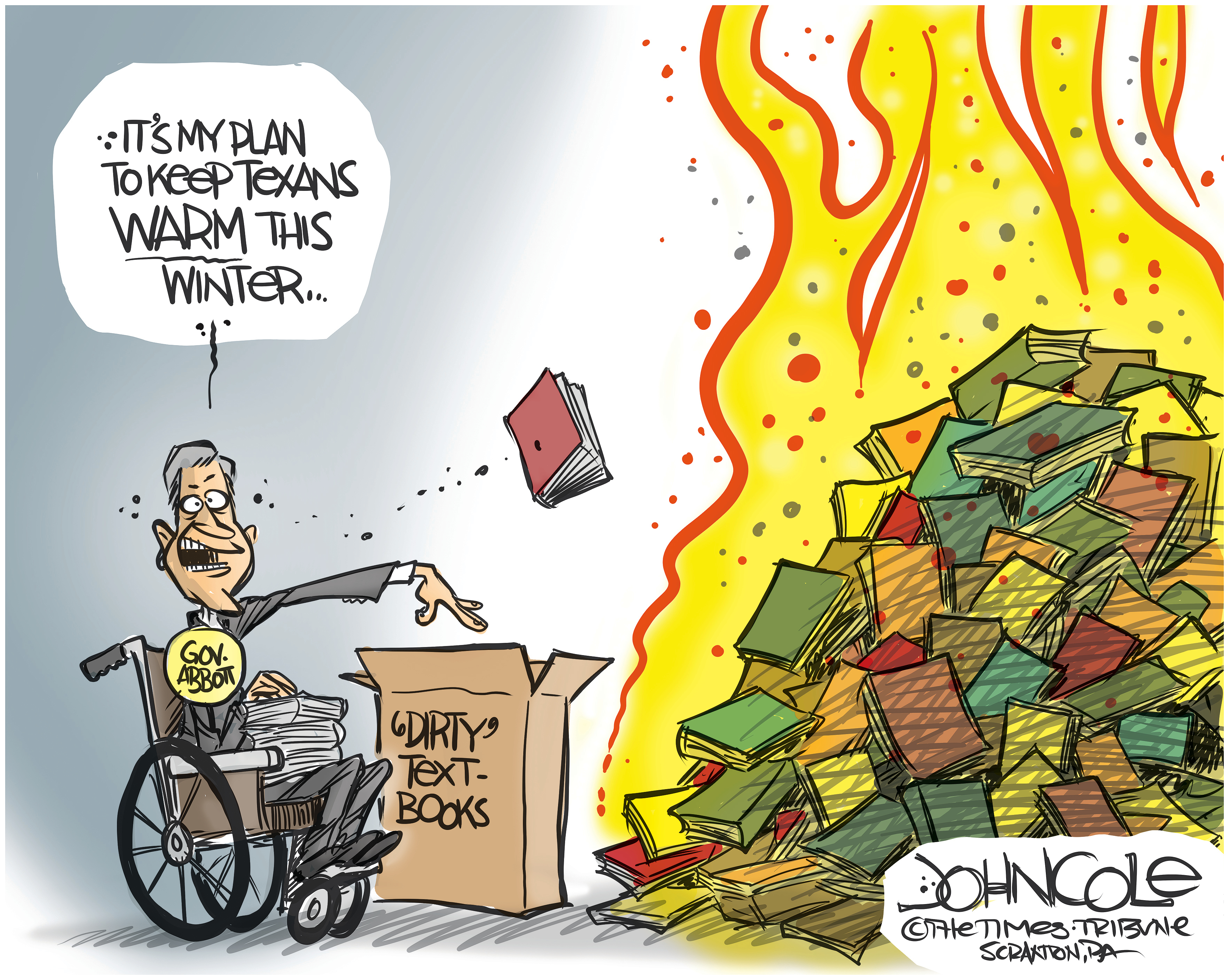
We’ve been here before. Back when I was in high school, parents wondered if books like To Kill a Mockingbird, Of Mice and Men and Brave New World were appropriate fare for teens. While they worried over those titles, we gleefully read The Lottery, Fahrenheit 451 and 1984 — books which now appear on most any modern list of banned or challenged books — and scoured the bookstore shelves for those other titles.
Back around the turn of the century (which now refers to the early 2000s, in case you, like me, still believe that 1984 was just couple of years ago), there was a small but vigorous movement to ban the Harry Potter books from many rural Texas schools. Because, of course, fictional magic = actual witchcraft.
Now we’re trying to ban from high school libraries books like The Handmaid’s Tale, The Bluest Eyes, V for Vendetta and (I kid you not), The Adventures of Huckleberry Fin.
With the exception of the Harry Potter series, every title I’ve mentioned here are STILL on some people’s radar as being inappropriate.
What the current raft of books that some parents want to burn — I mean, ban — have in common is that the subject matter deals with hard truths about racism, equality and gender identity. Come to think of it, every single title I’ve so far mentioned also deal with these things, but I get it that some parents don’t want to talk to their kids about these issues.
This has made recent news because some politicians, our governor included, are so concerned about a primary challenge that they quickly pander to the lowest common denominator in search of advantage. I’d have a better opinion of our governor’s sincerity if it weren’t that many of these books have been on school library shelves for his entire tenure in public office.
I have three grown children. We never forbade them from reading anything they could get their hands on — and, in the case of the boy-child, were positively elated when he finally picked up the habit on the regular.
We possibly noted that he or she might be a bit young for a particular book, and I rolled my eyes so hard you could hear it across the street when the youngest picked up a humorous YA fantasy series whose pilot lines regularly involved elaborate puns.
But reading is a very personal thing. It opens minds to strange and wonderful new worlds. The act should be roundly encouraged. Even if the books prompt uncomfortable questions. Especially if they prompt those questions … yes, even if the narrative involves elaborate puns.
I’m not insensitive to parental concerns about content. I get it. But, we can’t shield our kids from the world forever (have you seen what’s on the internet?! The kids have!) and I’d posit that it isn’t in our teenage children’s best interest to even try.
Let them read. Let parents guide them, if they are so inclined. If they aren’t, let librarians and teachers (you know, the experts) do it.
But banning books from high school libraries because they raise uncomfortable truths or encourage teenagers to think for themselves has never worked out well for anyone.
“There is more than one way to burn a book. And the world is full of people running around with lit matches.”
— Ray Bradbury
“Where they burn books they will, in the end, burn people too.”
— Salman Rushdie
“I know it when I see it, and … this is not that.”
— US Supreme Court Justice Potter Stewart
 The Ragged Edge @ WilCo Blues